Request click conversation or ask your question
Phone / Whatsapp: 0471 98 35 12
Vlaanderenstraat 53
9000 Ghent
Coaching on Work-Life Balance
Work-Life Balance Coaching supports you in improving the balance between your work and the rest of your life. Maybe you work too much and have too little time for all your tasks and plans. You may be high in your stress or low in your energy, but you don't have a burnout (yet?). Are you in doubt? With this test from the KULeuven you can quickly see where you stand on the spectrum from mild stress complaints to deep burnout.
Goals for Coaching on Work-Life Balance are e.g.:
I want more time for my family, friends or myself.
I want less stress so that at the end of the working day I still have energy for fun things.
I want to be able to let go of my work outside my working hours and worry less.
Work-Life-Balance trajectory
A typical Work-Life Balance trajectory consists of 6-10 biweekly conversations of 1.5-2 hours. We can adapt the exact frequency and duration of the calls to your availability and wishes - you are in charge.
To maximize the impact of your coaching you will receive -if you want- free home assignments to think about or experiment with. By Whatsapp you can occasionally ask me questions, share things, etc.
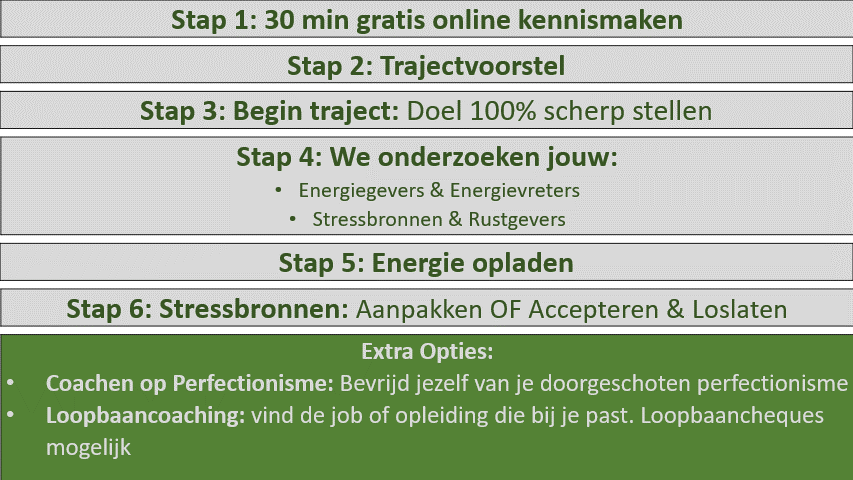
A Work-Life Balance coaching program consists of the following steps that we fine-tune based on your priorities.
Step 1: Click Conversation
Every trajectory starts with a free and non-binding online conversation that you can request here . In 30 minutes we look at what you want to work on and whether we match.
Step 2: Tailor-made proposal After our click conversation, I will send you a non-binding proposal for a trajectory that suits your specific coaching goals, your availability, budget, etc.
Step 3 & 4: Start trajectory: Specify goal and research your stress and energy sources
We get to work and specify the objective of the coaching as clearly as possible so that we know what you want to achieve. Then we look at what gives you stress and peace of mind. And which things give you energy or absorb it.
Step 5: Charging energy
If you are low in energy, we will first look very practically at how you can recharge your battery. We look at your sleep, exercise, nutrition, possibilities for relaxation, etc.
Step 6: Address stress sources where possible. Other: accept & let go
Some of your stress sources are within your influence and you can tackle them directly. On such stress sources we will provide Solution Focused Coaching with John Whitmore's GROW model. For example, how can you say NO more often to tasks at work so that you have more free time and are less stressed? How can you improve communication with your boss or your partner? How could you (temporarily) work less or delegate time-consuming, stressful tasks?
Another part of stress sources is beyond your control and sphere of influence. For example, you can't help it if COVID turns our society upside down or if someone close to you becomes seriously ill. In such cases, you can only adjust your behavior accordingly. Sometimes you can look at the source of stress differently. You accept the inevitable and let it go. That is often easier said than done, so we use a number of effective techniques for support: RET (Rational Emotive Training), ACT (Acceptance & Commitment Training) and Belief Coaching.
Additional coaching forms to structurally improve your Work-Life Balance
If you want to get rid of your excessive perfectionism, then Developmental Coaching on Perfectionism (OCP) is an effective addition to structurally improve your Work-Life Balance. With career coaching you can dive deep into career questions, so that you get a job that really fits who you are and what you stand for.
You can find the coaching rates here.